
Why People Choose White-Label SEO Instead of In-House SEO
As a digital marketing agency grows, expanding its SEO services can create new revenue opportunities and help strengthen client relationships. However, agencies must also decide how those services will be delivered.
Should you hire an in-house SEO team, partner with a white-label SEO provider, or combine both approaches?
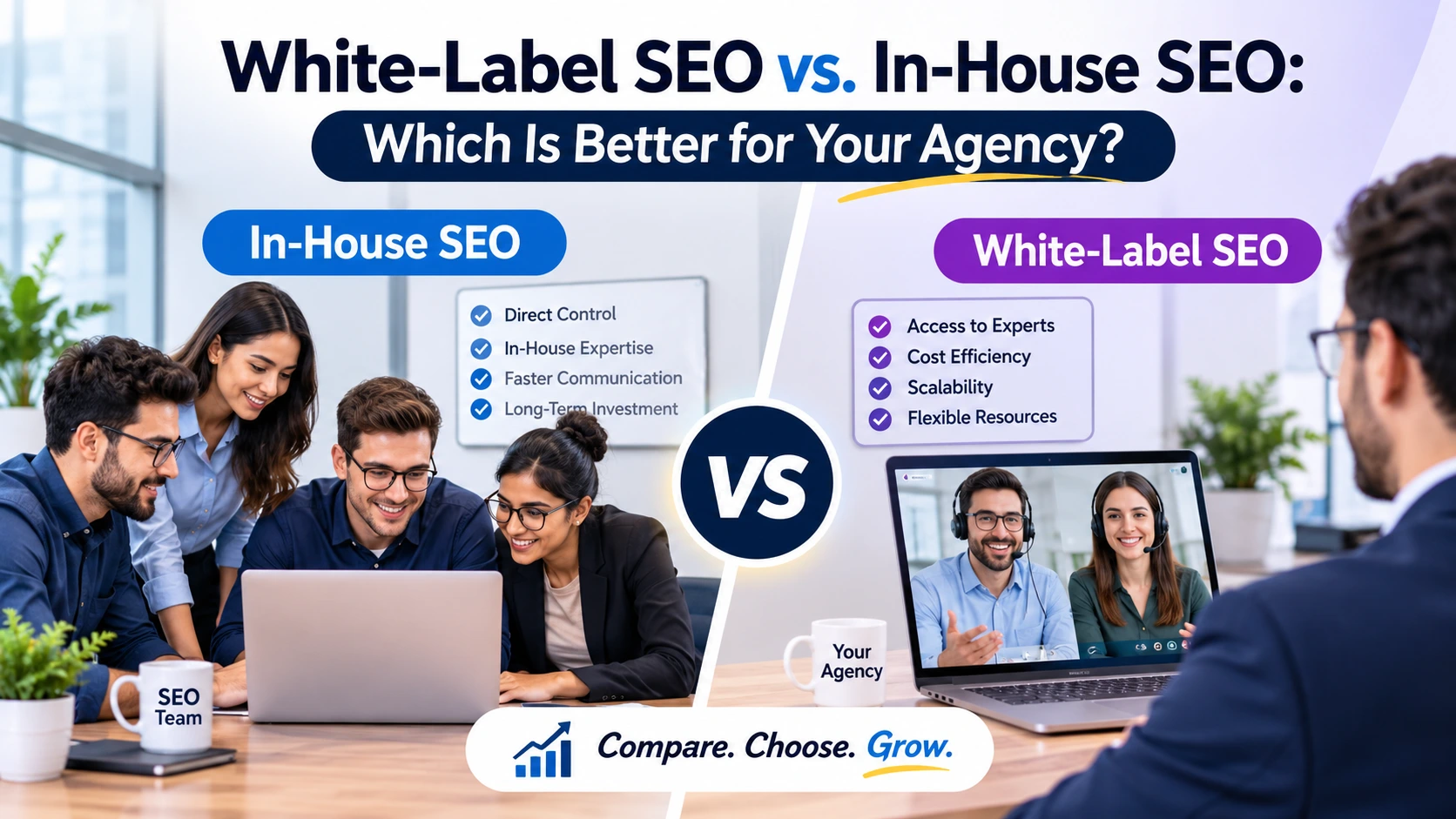
Each model has advantages and limitations. An internal team offers direct control over campaign delivery, while white-label SEO provides access to external expertise and additional resources without the same level of recruitment and infrastructure.
The right choice depends on your agency’s size, client portfolio, budget, service requirements,s and long-term business goals.
For agencies operating in the competitive US digital marketing market, understanding these differences can help create a more sustainable delivery model.
Understanding In-House SEO
In-house SEO means employing specialists directly within your agency to plan, manage,ge and execute search engine optimization campaigns.
Depending on the agency’s size, the team may include SEO strategists, technical SEO specialists, content writers, editors, link-building professionals,als and account managers.
These employees work within the agency and typically support internal processes, client requirements, and the overall marketing strategy.
An in-house team can provide direct control over daily activities. Employees can communicate closely with account managers, participate in client meetings, and adjust priorities as business requirements change.
However, building a capable SEO department requires investment in recruitment, salaries, training, software, and management. Agencies evaluating this approach may benefit from in-house SEO consulting when planning recruitment, internal processes,s and team responsibilities.
Understanding White-Label SEO
White-label SEO involves partnering with an external SEO provider that delivers services on behalf of your agency.
The agency sells the service under its own brand, while the provider completes the agreed work behind the scenes.
Depending on the arrangement, the provider may handle keyword research, technical audits, content development, on-page optimization, local SEO, link-building activities, and reporting.
The agency usually remains responsible for client communication, commercial agreements, campaign oversight,t and the overall service experience.
This model allows agencies to expand their capabilities through white-label SEO services for agencies without employing every specialist internally.
Agencies looking for ongoing external campaign support may also consider managed SEO services for agencies to coordinate recurring SEO activities.
1. Comparing the Cost of Each Model
Cost is often one of the first considerations when deciding between in-house and white-label SEO.
An internal SEO department involves recurring expenses that extend beyond employee salaries.
These may include:
- Recruitment and onboarding.
- Salaries and employee benefits.
- Training and professional development.
- SEO tools and software subscriptions.
- Management and administration.
- Office and equipment expenses.
- Additional recruitment as the client portfolio grows.
For a smaller agency, maintaining several full-time SEO specialists may create financial pressure, particularly if the number of active campaigns changes throughout the year.
White-label SEO usually follows a different cost structure. Agencies may pay through project-based pricing or monthly SEO retainers, depending on the provider’s pricing model.
This can make it easier to align delivery costs with client demand.
However, white-label SEO is not automatically cheaper. Agencies still need to account for partner fees, account management, quality reviews, and client communication.
The best comparison considers the full cost of delivering the service, not just the monthly provider fee or an employee’s salary.
2. Control Over SEO Strategy and Delivery
An in-house team generally provides more direct control over daily work.
Agency managers can assign tasks, review progress, discuss priorities,s and make adjustments without relying on an external organization’s availability.
This can be particularly useful when an agency handles complex campaigns that require frequent communication between SEO specialists, developers, content teams, and client-facing employees.
White-label SEO introduces another organization into the delivery process. The agency needs clear agreements covering responsibilities, timelines, approvals,s and communication.
However, outsourcing does not mean giving up strategic control.
Agencies can retain responsibility for campaign direction, client priorities, and final approvals while using external specialists for execution.
For example, an agency may decide which services and locations a client should prioritize, while its white-label partner handles keyword research, content production, and technical recommendations.
The key is to establish a clear division between strategic oversight and operational delivery.
3. Access to Specialist SEO Skills
SEO campaigns often require several different areas of expertise.
A technical SEO specialist may investigate indexing and website architecture, while a content strategist focuses on search intent and editorial planning. Other professionals may work on local SEO, analytics, or digital PR.
Hiring every specialist can be difficult for smaller agencies.
An in-house team may begin with one or two generalists, but those employees may not have the capacity or experience to handle every technical requirement.
A white-label provider may already have a team with different areas of expertise. This can give an agency access to a wider range of skills without recruiting each specialist individually. Agencies can also outsource specialist tasks such as white-label keyword research when they need additional research capacity.
However, choosing the right white-label SEO provider requires evaluating its capabilities, processes,s and experience carefully. Agencies should confirm which activities are handled internally, whether work is subcontracted, and how quality is reviewed.
For agencies with highly specialized clients, relevant industry experience can be just as important as general SEO knowledge.
4. Scalability and Workload Management
The ability to handle additional clients is an important factor in agency growth.
An in-house model usually requires additional recruitment when existing employees reach capacity. Hiring takes time, and new employees may need training before they can work independently.
This can make rapid expansion challenging.
White-label SEO can offer more flexible delivery capacity. Reliable SEO fulfilment services can help agencies manage additional campaign requirements without immediately expanding their permanent workforce.
For example, an agency may manage a small group of SEO clients internally and use a white-label partner when it signs additional accounts.
This can help manage workload fluctuations without immediately increasing permanent staffing costs.
However, scalability should be evaluated based on actual delivery capacity. A provider must be able to maintain agreed standards as the number of campaigns increases.
5. Communication and Client Relationships
In-house teams often have an advantage when it comes to immediate communication.
SEO specialists work within the agency, making it easier for account managers to ask questions, arrange discussions,s and coordinate urgent tasks.
This can be useful for campaigns involving frequent client meetings or complex website changes.
With white-label SEO, communication depends on the provider’s processes. Agencies need to understand how updates are shared, how quickly questions are answered, ed and who handles urgent requests.
The client relationship, however, should remain with the agency.
Clients should have a clear point of contact who understands their business and can explain campaign decisions.
Whether SEO is delivered internally or externally, communication should be consistent, professional, and focused on the client’s objectives.
6. Quality Control and Accountability
Both models require quality control.
An in-house team may be easier to supervise directly, but internal delivery does not automatically guarantee high-quality work. Employees still need clear standards trainingn, training, and performance reviews.
White-label SEO requires an additional review process because the agency is responsible for work completed by an external provider.
Before sharing deliverables, agencies should check:
- Whether keyword research reflects the client’s audience.
- Whether content is accurate and useful.
- Whether technical recommendations are actionable.
- Whether link-building methods are appropriate.
- Whether reports contain correct data.
- Whether agreed deadlines and deliverables have been met.
A reliable white-label provider should have its own quality assurance procedures. The agency should still review the work before presenting it to clients.
A white-label SEO dashboard can also help agencies present campaign progress and performance information under their own branding.
Accountability must also be clearly defined. The agency remains responsible for the service it sells, even when another team handles execution.
7. Flexibility Across Different Client Requirements
An agency may serve businesses across several industries, each with different SEO needs.
A local restaurant may require Google Business Profile support, location-based keywords, review management,nt and white-label local SEO services to support campaign delivery. An ecommerce company may need technical optimization, product page improvements,nts and category content. A professional services firm may require educational articles and service-specific landing pages.
An in-house team can develop deep knowledge of the agency’s recurring client types. However, its capabilities may be limited by the skills available within the department.
A white-label provider may offer a broader range of services, but agencies should confirm that its approach can be adapted to individual campaigns.
The best model is one that supports customization rather than forcing every client into the same SEO package.
8. Comparing the Two Models
The following table summarizes some of the main differences.
| Business consideration | In-house SEO | White-label SEO |
|---|---|---|
| Staffing | Requires direct recruitment | Uses an external delivery team |
| Cost structure | Ongoing employment and operating costs | Provider fees based on agreed services |
| Daily control | Direct internal supervision | Managed through partnership agreements |
| Specialist access | Depends on employees hired | May provide access to multiple specialists |
| Scalability | Often requires additional hiring | Can offer flexible delivery capacity |
| Communication | Direct internal coordination | Requires structured partner communication |
| Quality control | Internal management and review | Shared responsibility with agency oversight |
| Client branding | Delivered directly by the agency | Delivered under the agency’s brand |
Neither model is universally better. The right approach depends on what the agency needs to achieve and how it wants to manage its resources.
9. The Hybrid Model: Combining In-House and White-Label SEO
Many agencies do not need to choose only one approach.
A hybrid model combines internal strategic oversight with external specialist delivery.
For example, an agency may employ an SEO director or account strategist who manages client relationships, sets campaign priorities, and reviews performance. Agencies that need additional support can also explore a dedicated SEO team while retaining internal strategic oversight.
The white-label partner can then support keyword research, technical audits, content production, on-page optimization, and reporting.
This structure offers several advantages.
Internal strategic control: The agency retains ownership of campaign direction and client communication.
Access to additional skills: External specialists support activities that the internal team cannot manage alone.
Flexible capacity: The agency can use external resources when client demand increases.
More focused internal roles: Employees can spend more time on strategy, quality review,e w and business development.
A hybrid model can be particularly useful for agencies that have an established client base but do not want to expand their internal SEO department too quickly.
10. How to Decide Which Model Fits Your Agency
The decision should begin with an honest assessment of your current operations.
Consider the following questions:
How many SEO clients do you manage? A small portfolio may not justify a large internal team, while a larger and more predictable client base may support permanent specialist roles.
What services do clients need? If campaigns require a wide range of technical and content skills, external expertise may help fill capability gaps.
How predictable is your workload? Agencies with fluctuating demand may benefit from a flexible delivery arrangement.
How much direct control is necessary? Complex campaigns may require close internal coordination, while more standardized work may be suitable for an external partner.
What is your financial position? Compare recruitment and operating costs against the full cost of outsourcing.
What are your long-term plans? Consider whether you want to build a specialist SEO department, expand your agency’s service portfolio, or develop a hybrid model.
The answers will help determine which structure is most practical.
Build an SEO Delivery Model That Supports Growth
In-house SEO and white-label SEO offer different ways to deliver services, and both can support a successful agency.
An internal team provides direct control and closer integration with daily operations. A white-label partner offers access to specialist skills and flexible delivery capacity without requiring the same level of internal recruitment.
For many growing agencies, a combination of both approaches can provide a useful balance.
The important thing is to build a model that supports reliable delivery, protects service quality, and gives the agency enough flexibility to respond to new opportunities.
Growth should not mean increasing operational pressure with every new client. With the right delivery structure, agencies can expand their SEO services while keeping costs, responsibilities, and client expectations manageable.