
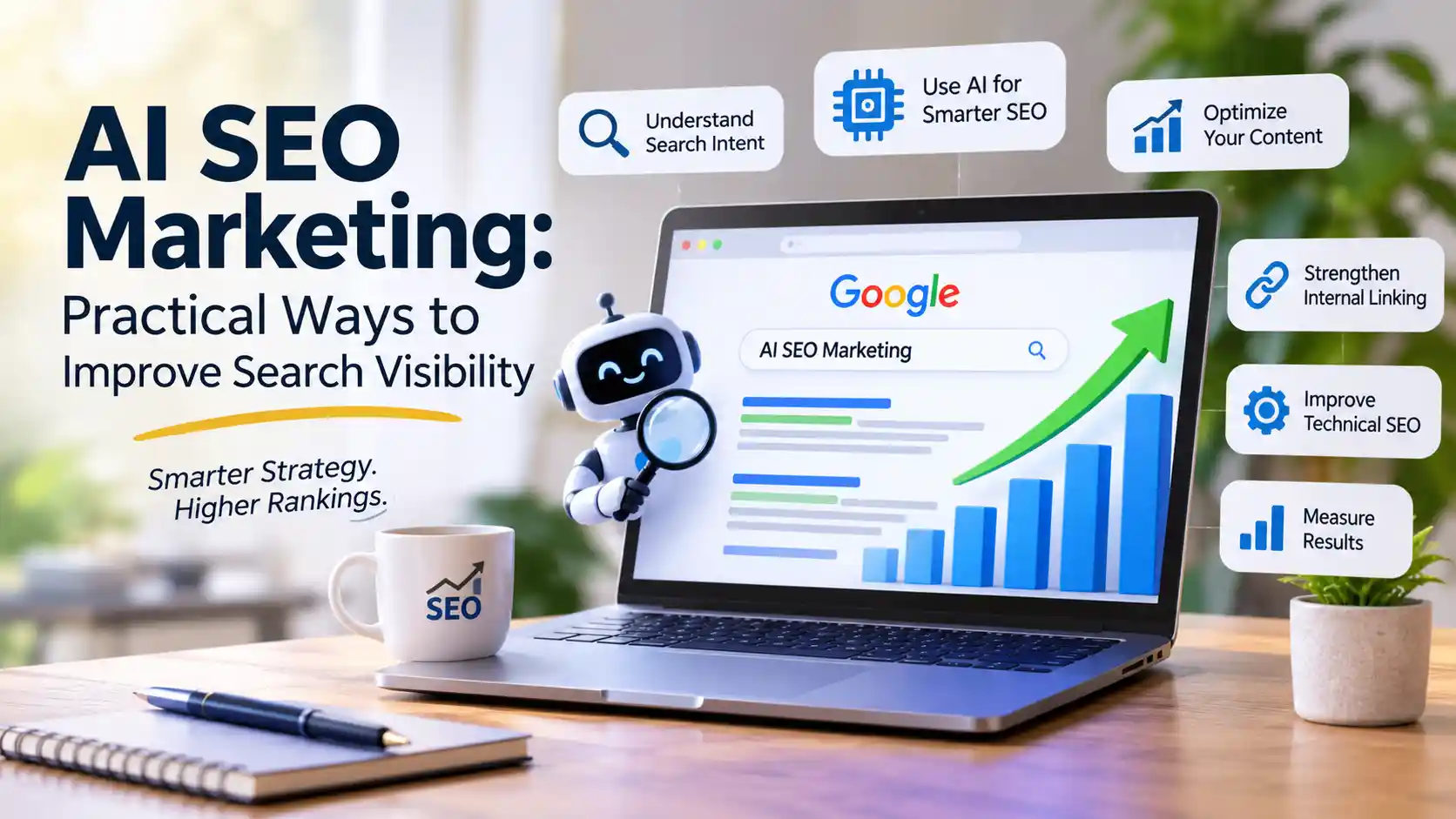
How AI SEO Marketing Helps Businesses Improve Online Visibility
Search engine optimization is evolving as artificial intelligence changes how people discover information, evaluate businesses, and make purchasing decisions. From AI-powered search experiences to smarter content tools, businesses now have more opportunities to understand their audiences and improve their online visibility.
However, successful AI SEO marketing is not simply about using artificial intelligence to produce more content. It involves combining AI capabilities with sound SEO practices, useful information, technical website improvements, and a clear understanding of customer needs.
For businesses in the United States, this shift creates an opportunity to reach potential customers across traditional search engines and emerging AI-driven discovery platforms. Companies that adapt thoughtfully can improve their search presence, attract relevant website traffic, and build stronger connections with their audiences.
This guide explores practical ways to use AI in SEO marketing, improve search visibility, and develop a strategy that supports long-term business growth.
What Is AI SEO Marketing?
AI SEO marketing refers to using artificial intelligence technologies to support and improve search engine optimization activities. These technologies can analyze information, identify patterns, assist with content development, understand search intent, and help marketers make more informed decisions.
Traditional SEO focuses on improving a website’s ability to appear in relevant search results through keyword research, content optimization, technical performance, and authority building. AI can make many of these activities more efficient by helping marketers process information and identify opportunities.
For example, an AI-powered tool may help a marketing team:
- Discover related search terms and content opportunities.
- Analyze competing pages and identify missing topics.
- Organize keywords according to search intent.
- Develop content outlines and initial drafts.
- Identify internal linking opportunities.
- Review website performance and highlight potential issues.
- Generate ideas for improving existing content.
AI can support the SEO process, but it does not replace strategic planning, subject knowledge, editorial judgment, or an understanding of customers.
The strongest approach is to use AI as an assistant while keeping people responsible for accuracy, originality, and the overall quality of the content.
Why AI Is Becoming Important for SEO Marketing
Search behavior is changing. People still use traditional search engines to find products, services, and information, but they are also encountering AI-generated summaries, conversational search experiences, and answers that combine information from multiple sources.
This means businesses need to think beyond individual keyword rankings. They should focus on becoming useful, credible sources of information that search systems and potential customers can understand.
Several developments make AI increasingly relevant to SEO.
1. Search Intent Is Becoming More Important
A keyword does not always explain what a person actually wants.
Someone searching for “best cybersecurity software for small businesses” may be comparing products, researching features, or preparing to request a demonstration. A page that only repeats the keyword without answering these questions is unlikely to satisfy the visitor.
AI tools can help marketers examine related searches, identify common questions, and organize topics according to user intent.
Businesses can use this information to create pages that address the full customer journey, from early research to product evaluation and purchasing decisions.
2. Search Experiences Are Becoming More Conversational
People increasingly use complete questions rather than short keyword phrases.
For example, instead of searching for “accounting software,” a user might ask, “Which accounting software is suitable for a small business with multiple employees?”
Businesses should consider these natural-language searches when developing website content.
Creating useful FAQs, detailed service explanations, comparison guides, and educational articles can help address the questions potential customers are asking.
3. Competition for Online Attention Is Increasing
Publishing content is easier than ever, but producing genuinely useful information remains challenging.
Businesses can use AI to research topics, identify content gaps, and improve their editorial processes. However, simply publishing large volumes of AI-generated articles can result in repetitive, shallow, or inaccurate content.
A stronger strategy prioritizes original insights, practical examples, clear explanations, and information that genuinely helps readers.
Practical Ways to Use AI to Improve SEO Performance
AI can support different stages of an SEO campaign. The key is to connect each application to a specific marketing objective rather than adopting tools without a clear purpose.
1. Use AI for Smarter Keyword Research
Keyword research helps businesses understand how potential customers search for their products and services.
AI-powered research tools can assist with identifying related keywords, grouping search terms, and exploring questions that people may ask before making a decision.
For example, a US-based cybersecurity company targeting small and medium-sized businesses might identify keyword opportunities such as:
- Cybersecurity solutions for small businesses
- Managed security services for growing companies
- Cloud security solutions for businesses
- Network security assessment services
- Cybersecurity compliance support
- Data protection solutions for organizations
Instead of creating a separate page for every variation, marketers should organize these terms into relevant topic groups.
The next step is to identify the search intent behind each group. Some searches indicate a need for educational information, while others suggest that a user is comparing providers or actively looking for a solution.
This approach helps businesses create more focused pages and avoid unnecessary keyword repetition.
2. Create More Helpful Content With AI Assistance
Content marketing remains an important part of SEO. Businesses need informative pages that explain their services, answer customer questions, and demonstrate relevant expertise.
AI can help accelerate content planning and development.
For instance, marketers can use AI to:
- Generate article topic ideas.
- Prepare structured content outlines.
- Identify questions that should be answered.
- Improve clarity and readability.
- Suggest relevant examples.
- Identify missing sections in existing articles.
- Repurpose long-form content into shorter educational resources.
However, AI-generated drafts should never be treated as automatically publishable.
Every article should be reviewed for factual accuracy, originality, relevance, and usefulness. Industry-specific information should be checked by someone with appropriate knowledge.
A healthcare technology company, for example, should have qualified reviewers check claims about healthcare regulations, data security, and patient information before publishing them.
The objective is not to publish more content simply because production is faster. It is to publish better content that meets real audience needs.
3. Optimize Existing Website Content
Many businesses focus heavily on creating new pages while overlooking opportunities within their existing websites.
AI can help review existing content and identify potential improvements.
A content audit may reveal:
- Pages with outdated information.
- Articles that no longer match search intent.
- Service pages with unclear explanations.
- Missing answers to common customer questions.
- Weak internal linking structures.
- Overlapping content targeting similar topics.
- Pages with limited supporting information.
For example, a software company may have an article explaining the benefits of cloud security. If the article does not address deployment options, common risks, implementation considerations, or business requirements, it may not fully meet the needs of its intended audience.
An updated article can provide more practical detail and link to relevant service pages.
Content optimization is also becoming increasingly important for businesses that want their websites to perform well across traditional and AI-powered search environments. AI content optimization involves improving content structure, topical relevance, clarity, search intent alignment, and the overall usefulness of website information.
Businesses should regularly evaluate whether their existing pages provide complete answers, demonstrate relevant expertise, and communicate information in a way that both visitors and search systems can understand.
Learn more about AI Content Optimization to explore ways to improve content quality and strengthen your website’s search visibility.
4. Improve Content for AI-Powered Search Experiences
AI-powered search experiences can summarize information and present answers using content from multiple sources.
Businesses cannot guarantee that their websites will appear in these experiences. However, they can improve the clarity, accessibility, and usefulness of their content.
Practical improvements include:
- Answering important questions directly.
- Using descriptive headings.
- Explaining specialist terminology.
- Providing clear information about products and services.
- Supporting factual claims with credible sources.
- Maintaining consistent business information.
- Publishing original insights and relevant examples.
- Ensuring important website content can be accessed by search systems.
For example, a managed IT services provider should clearly explain what its services include, which businesses it supports, what problems it solves, and how customers can request assistance.
Clear, well-organized information benefits human visitors as well as search systems.
Understanding Generative Engine Optimization (GEO)
One important development in AI-driven search is Generative Engine Optimization (GEO). GEO focuses on improving how a brand’s information can be discovered, understood, and referenced by generative AI platforms.
Unlike traditional SEO, which primarily focuses on visibility in conventional search results, GEO considers how businesses can strengthen their presence in AI-generated responses and conversational discovery experiences.
Businesses can support their GEO strategies by:
- Publishing informative and well-structured content.
- Demonstrating subject expertise.
- Providing accurate and consistent brand information.
- Supporting important statements with credible sources.
- Creating content that directly addresses customer questions.
- Building a relevant online presence through legitimate mentions and references.
Companies looking to improve their presence across generative AI platforms can explore Generative Engine Optimization (GEO) services to understand how this approach can complement traditional SEO.
Understanding Answer Engine Optimization (AEO)
Answer Engine Optimization (AEO) focuses on structuring website content to provide clear, relevant answers to questions asked through search engines and AI-powered answer platforms.
People increasingly search using conversational questions such as:
- What are the benefits of AI SEO marketing?
- How does generative engine optimization work?
- How can businesses improve AI search visibility?
- What is the difference between SEO, GEO, and AEO?
Businesses can address these queries by developing useful FAQs, providing concise explanations, using descriptive headings, and organizing information logically.
AEO helps make website information easier to understand and use in answer-focused search experiences. It complements traditional SEO by emphasizing direct answers and the quality of information provided.
To explore how your business can improve its visibility in answer-driven search experiences, learn more about Answer Engine Optimization (AEO).
5. Strengthen Internal Linking With AI Support
Internal links connect related pages within a website. They help visitors discover additional information and allow search engines to understand how different pages relate to one another.
AI tools can assist with identifying relevant linking opportunities across existing content.
Consider a marketing agency website containing articles about technical SEO, local SEO, content marketing, and website optimization.
An article about local SEO could link naturally to a related guide on Google Business Profile optimization. A service page could link to an educational article explaining how the service works.
A useful internal linking strategy should:
- Connect closely related topics.
- Use descriptive anchor text.
- Help visitors find relevant information.
- Support important service and category pages.
- Avoid adding links where they do not provide value.
AI suggestions should be reviewed manually to ensure that every link makes sense in context.
How to Combine AI SEO With Traditional SEO Fundamentals
AI can improve the efficiency of SEO activities, but the fundamentals of search optimization remain important.
Businesses should continue investing in the areas that support website quality and discoverability.
Technical SEO
A technically sound website helps search engines access, understand, and index its content.
Important areas include:
- Website crawlability and indexability.
- Mobile-friendly page experiences.
- Secure HTTPS connections.
- Logical website architecture.
- Descriptive page titles and meta descriptions.
- Appropriate canonical tags.
- XML sitemaps.
- Structured data where relevant.
- Page performance and usability.
AI tools can help identify potential technical issues, but technical recommendations should be validated before implementation.
Helpful, Original Content
Content should be created primarily to help the intended audience.
Businesses should explain their expertise, provide useful guidance, and answer questions more effectively than a generic overview would.
Original research, first-hand experience, practical examples, expert commentary, and detailed service knowledge can make content more valuable.
AI can assist with writing and research organization, but it should not become a substitute for genuine business expertise.
Authority and Trust
Trust matters when people are evaluating a business.
Companies can strengthen their credibility through:
- Accurate company information.
- Clear service descriptions.
- Relevant case studies.
- Genuine customer testimonials.
- Qualified author and reviewer information.
- Reliable references and sources.
- Transparent contact and support details.
Businesses should also maintain a consistent online presence and earn relevant mentions and links through legitimate marketing and relationship-building activities.
Measuring the Success of an AI SEO Strategy
AI SEO marketing should be measured through meaningful business and website performance indicators.
Publishing more articles or using more AI tools does not automatically mean an SEO campaign is successful.
Businesses should monitor several areas.
Organic Search Performance
Use Google Search Console and other suitable analytics tools to evaluate:
- Search impressions.
- Organic clicks.
- Search queries.
- Click-through rates.
- Page-level performance.
- Indexing issues.
- Search visibility across relevant topics.
These indicators help marketers understand whether their website is becoming more visible for relevant searches.
Website Engagement
Website analytics can provide insight into what visitors do after arriving.
Useful measurements may include:
- Engaged sessions.
- Important page visits.
- Contact form submissions.
- Phone calls.
- Demo requests.
- Appointment bookings.
- Downloads of relevant resources.
The right metrics depend on the business model and the purpose of each page.
Lead Quality and Conversions
For many businesses, attracting qualified enquiries is more valuable than generating large amounts of untargeted traffic.
A B2B software company, for example, may receive fewer enquiries but generate stronger opportunities from visitors who have researched its services and understand its offering.
Businesses should connect SEO reporting with lead quality, sales opportunities, and conversion performance wherever practical.
Visibility Across AI Search Platforms
Where reliable reporting is available, businesses can also monitor whether their brand or content appears in relevant AI-generated answers and referral traffic from AI-powered platforms.
These measurements can be difficult to standardize, so they should be treated as supplementary indicators rather than replacements for established SEO reporting.
Why Businesses Should Conduct an AI Visibility Audit
An AI visibility audit can help businesses understand how their brands appear across AI-powered search and discovery experiences.
This process may involve evaluating:
- Whether the brand appears in relevant AI-generated answers.
- How the business is described across AI platforms.
- Whether its website content addresses important customer questions.
- How competitors are represented in relevant AI search results.
- Whether important brand information is consistent across online sources.
- Which content opportunities could improve brand discoverability.
For example, a US-based digital marketing agency may want to understand whether AI platforms recognize its expertise in technical SEO, content marketing, or generative engine optimization.
An audit can help identify gaps and provide direction for future content and optimization activities.
Businesses interested in evaluating their current AI search presence can explore an AI Visibility Audit to identify opportunities for improving brand visibility across emerging search experiences.
Common AI SEO Mistakes Businesses Should Avoid
Using AI without a clear strategy can create new problems instead of improving search performance.
Some common mistakes include:
Publishing large volumes of unreviewed content: Automatically generated articles may contain inaccuracies, repetitive explanations, or information that provides little value.
Focusing only on keywords: Search visibility depends on more than including target phrases. Content must satisfy the user’s actual needs.
Ignoring technical SEO: Even useful content can struggle to perform when important pages are inaccessible, poorly structured, or difficult to navigate.
Using AI-generated information without verification: AI tools can produce incorrect or outdated statements. Important claims should be checked against reliable sources.
Creating content without business relevance: Articles should connect naturally to the products, services, expertise, and questions relevant to the target audience.
Expecting immediate results: SEO performance develops over time. Businesses should evaluate progress consistently rather than expecting instant improvements.
Building a Practical AI SEO Marketing Strategy
Businesses do not need to transform their entire marketing operation at once. A structured approach makes AI adoption more manageable.
A practical starting process includes:
- Review the existing website: Identify technical issues, content gaps, and pages that need improvement.
- Understand the target audience: Research customer questions, search behavior, and buying requirements.
- Prioritize keyword opportunities: Focus on relevant searches that align with business objectives.
- Develop a content plan: Create useful articles, service pages, FAQs, and supporting resources.
- Use AI selectively: Apply AI to research, planning, analysis, and editing where it provides measurable value.
- Review everything before publishing: Check facts, originality, relevance, and content quality.
- Improve internal linking: Connect related pages and make important information easier to discover.
- Measure performance: Track organic visibility, qualified enquiries, and meaningful conversions.
- Evaluate AI visibility: Monitor brand presence and identify opportunities across relevant AI-driven discovery platforms.
This process allows businesses to benefit from AI without losing sight of the fundamentals that make SEO effective.
How Professional AI SEO Services Can Help Your Business
Developing an effective AI SEO strategy requires more than using artificial intelligence for keyword research or content creation. Businesses need a coordinated approach that combines traditional search engine optimization, technical website improvements, content quality, search intent analysis, and visibility across emerging AI-powered platforms.
Professional AI SEO services can help businesses identify optimization opportunities, improve existing website content, strengthen search visibility, and develop strategies that align with changing customer search behavior.
An effective AI SEO strategy may include:
- AI-assisted keyword research and search intent analysis.
- Technical SEO audits and website improvements.
- Content planning and AI content optimization.
- Generative Engine Optimization (GEO).
- Answer Engine Optimization (AEO).
- AI visibility monitoring and analysis.
- Internal linking and website structure improvements.
- Performance measurement and ongoing optimization.
For US businesses looking to attract relevant organic traffic and improve their presence across traditional search engines and AI-powered discovery platforms, working with an experienced digital marketing team can make the optimization process more structured and effective.
At Next Level Marketing Technologies, businesses can explore our AI SEO Services to learn more about improving online visibility through AI-supported search optimization strategies.
Final Thoughts
AI SEO marketing is changing how businesses approach search visibility, content development, and digital marketing strategy. It offers practical ways to research keywords, improve website content, identify optimization opportunities, and understand customer search behavior.
However, AI alone does not create a successful SEO campaign. Businesses still need technically accessible websites, useful original content, credible information, relevant keyword targeting, and a clear understanding of their customers.
For US businesses looking to strengthen their online presence, the most effective approach is to combine AI-powered efficiency with human expertise and established SEO practices.
By using AI thoughtfully, reviewing content carefully, and measuring results against meaningful business goals, companies can build a search strategy that supports sustainable visibility and attracts more relevant customers over time.